
What is the PREVENT™ Calculator?
The PREVENT™ Calculator integrates the American Heart Association (AHA) PREVENT cardiovascular risk equations directly into Elation. It calculates 10-year and 30-year risk estimates for total cardiovascular disease (CVD), atherosclerotic cardiovascular disease (ASCVD), and heart failure (HF) using chart data — eliminating the need to use external tools like MDCalc or the ACC estimator. Elation automatically pre-fills required inputs from the patient’s chart, including demographics, vitals, labs, medications, problem list, and social history. Results appear immediately with AHA/ACC-aligned guidance, intended to support shared decision-making between clinician and patient regarding potential interventions. PREVENT™ may be used as- a screening tool to help determine a person’s potential risk of cardiovascular disease, atherosclerotic cardiovascular disease, and heart failure.
- one of the shared decision-making tools to evaluate treatment decisions between a patient and their healthcare professional.
Who can use PREVENT™?
The PREVENT™ calculator is a tool in Elation AI for clinicians and other healthcare professionals to estimate patients’ risk for cardiovascular disease (CVD). Risk estimates are intended to be guides and a starting point for a clinician-patient discussion for the primary prevention of CVD.Identifying patients for PREVENT™ risk assessments
The PREVENT™ calculator serves as a tool for patients aged 30-79 without a documented history of cardiovascular disease. Elation AI will flag the PREVENT™ calculator as inappropriate when a patient’s Problem List includes one or more of the following conditions:- cardiovascular diseases
- severe subclinical cardiovascular diseases
- end-stage kidney disease
- limited life expectancy
What information is required for PREVENT™ calculations?
The following structured information is required for PREVENT™ calculations and will be pulled directly from the patient’s demographics, vitals, and lab results if they’re in the chart.- Patient’s age
- Patient’s sex assigned at birth
- Systolic blood pressure
- BMI
- Total cholesterol
- HDL cholesterol
- eGFR
- History of diabetes
- Active smoking status
- Active blood pressure medication(s)
- Active statin medication(s)
- HbA1c
- UACR
- Patient’s zip code (to estimate Social Deprivation Index (SDI))
Workflow Instructions
Accessing the PREVENT™ Calculator through Elation AI
- Open the patient chart.
- Go to the search bar a the top of the chart and type a query about cardiovascular risk, such as “What is this patient’s PREVENT™ score?” or “cardiovascular risk.”
- If all required fields are available, Elation AI runs the PREVENT™ calculation and displays the results.
- If any required fields are missing, Elation AI will notify you to obtain or provide the missing information in a follow up response.
Understanding PREVENT™ results
PREVENT™ may be used as a screening and shared decision-making tool to help determine a person’s potential risk of cardiovascular disease, atherosclerotic cardiovascular disease, and heart failure, as well as to evaluate treatment decisions between a patient and their healthcare professional. PREVENT™ results include:- Risk category
- Low Risk, Borderline Risk, Intermediate Risk, or High Risk
- 10-year and 30-year risk estimates for total cardiovascular disease (CVD), atherosclerotic cardiovascular disease (ASCVD), and heart failure (HF).
- Clinical guidance based on the results
- AHA/ACC-aligned guidance for statin therapy, blood pressure treatment, lifestyle modifications, kidney and diabetes considerations, and heart failure notes
- A summary of the current status of the patient’s condition.
Copying PREVENT™ results
Click the copy icon to copy PREVENT™ results and then paste them into notes or letters.
Missing or out-of-range data
Missing inputs
If some inputs are missing (e.g., HbA1c or UACR), PREVENT™ uses the appropriate base model or adjusted model (base + HbA1c, base + UACR) to calculate risk where mathematically valid. This matches the behavior of the official AHA online calculator.Out-of-range values
If a patient’s values fall outside the PREVENT™-indicated range, Elation flags the out-of-range condition, runs the calculation using the nearest in-range values, and labels the results as directional. The calculation is not blocked.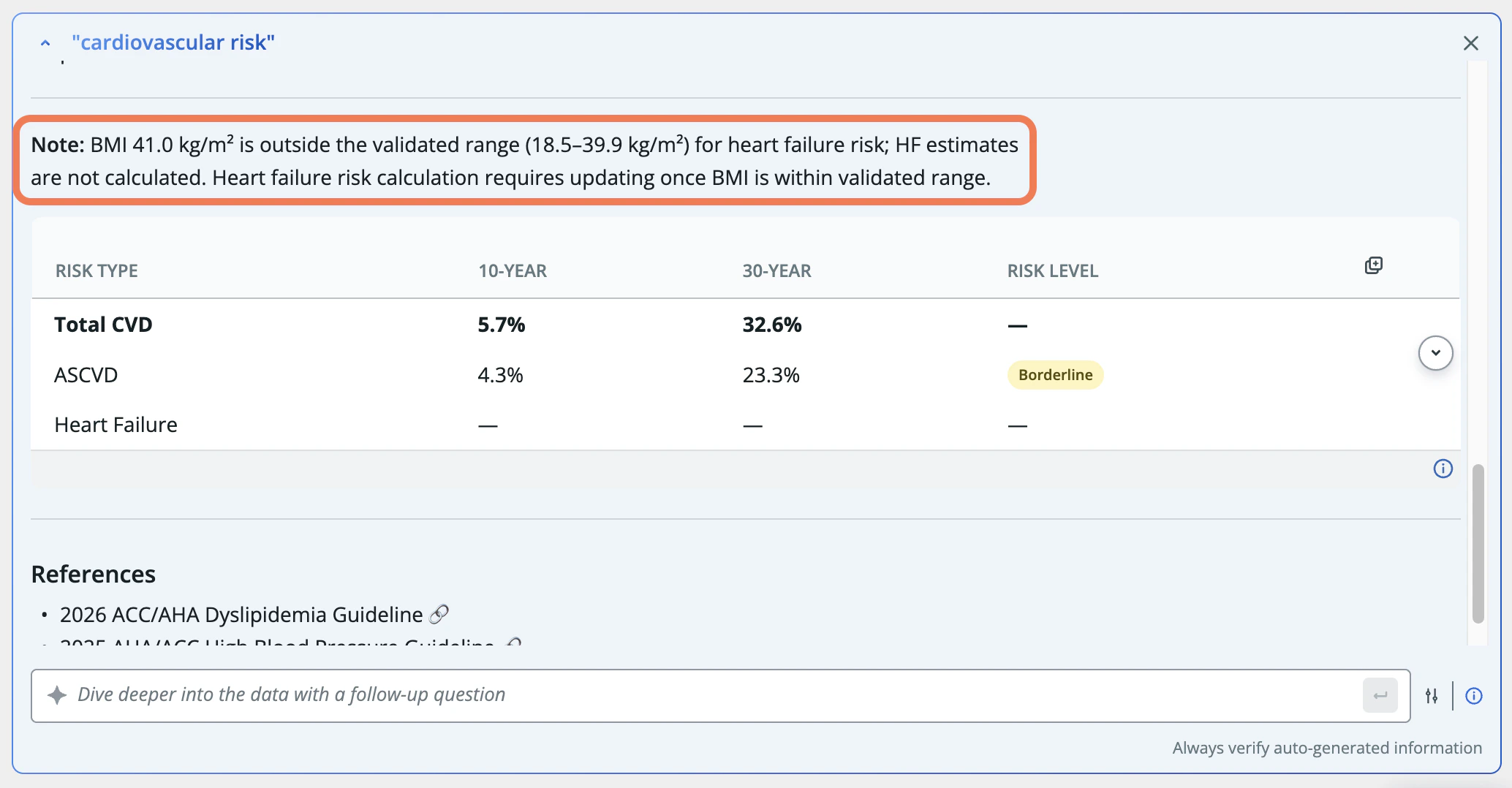
Resources
American Heart Association PREVENTᵀᴹ Equations Frequently Asked QuestionsFrequently Asked Questions
Can I use PREVENT™ for patients already on statins or blood pressure medications?
Yes. PREVENT™ accepts medication status inputs. Guidance messaging differentiates patients on vs. not on statins or antihypertensives, focusing on treatment intensity and monitoring rather than initiation alone.Can I request other risk calculators (e.g., ASCVD pooled cohort)?
Not yet. PREVENT™ is the only integrated calculator available. For other tools, use MDCalc in the meantime. Additional calculators may be added in the future.Where are PREVENT™ results stored?
During each calculation session, results can be accessed via the calculator dialog or Elation AI and copied directly into notes or messages.The PREVENT™ equations were developed by select members of the American Heart Association Cardiovascular-Kidney-Metabolic Scientific Advisory Group. The risk equations were derived and validated in a large, diverse sample of over 6 million individuals.[1], [2]The information derived from the use of PREVENT™ is based on PREVENT™ 1.0.0. Updates and future adaptations of PREVENTᵀᴹ may yield different results and conclusions.[1] Khan SS, Matsushita K, Sang Y, et al. Development and Validation of the American Heart Association Predicting Risk of Cardiovascular Disease EVENTs (PREVENT™) Equations. Circulation 2023. DOI: 10.1161/CIRCULATIONAHA.123.067626(link opens in new window).[2] Khan SS, Coresh J, Pencina MJ, et al. Novel Prediction Equations for Absolute Risk Assessment of Total Cardiovascular Disease Incorporating Cardiovascular-Kidney-Metabolic Health: A Scientific Statement From the American Heart Association. Circulation 2023;148(24):1982-2004. DOI: 10.1161/CIR.0000000000001191(link opens in new window).